

Most organisations produce monthly financial reports. But not all reporting is useful reporting. Too often, the month-end pack becomes a historical recap rather than a tool for decision-making.
If your accounting system is like most financial systems, your month-end reports may look familiar:
- Static, fixed-format financial statements
- Dense tables of numbers that are hard to interpret
- Limited flexibility to present data in the way you actually want to see it
- Little to no commentary to explain what’s driving results
- And a board that still asks, “So… what does this mean?”
The numbers are there. But the insight isn’t.
Data Isn’t the Problem. Context Is.
Finance leaders, CFOs, and business owners don’t struggle with a lack of data. What’s missing is the translation of the data into meaning.
When explanation is missing, decision-making slows down. When decision-making slows down, opportunities get missed.
Good reporting doesn’t just report history. It tells a story. It helps the business understand what changed, why it changed, and what should happen next.
The Good News
You probably don’t need to replace your accounting system. Replacing financial systems is expensive, disruptive, and often unnecessary. The system is usually doing its job — recording transactions accurately.
What’s missing is a way to communicate the results. This is where Solver comes in. Solver sits on top of your existing financial system and allows you to:
- Pull in actuals and budgets automatically
- Pull through other data that might be relevant to the business, not just financials from the General Ledger, but operational data from a variety of sources.
- Present financials in a clear, decision-ready layout, in a variety of meaningful formats
- Add narrative commentary directly within the report
- Highlight key variances and performance drivers clearly and consistently
Instead of replacing the engine, you simply upgrade the dashboard.
Example 1: Narrative Reporting in Action
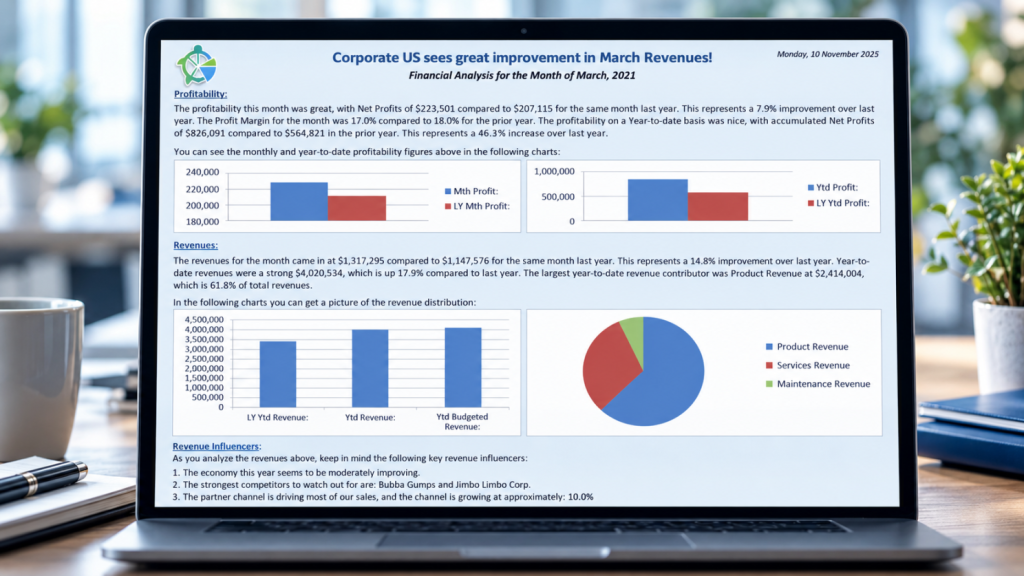
Narrative commentary sits alongside the numbers so the key points are understood immediately — before questions need to be asked. Narrative can be both automated and formatted based on data within the report.
Example 2: Clear, Well-Structured P&L
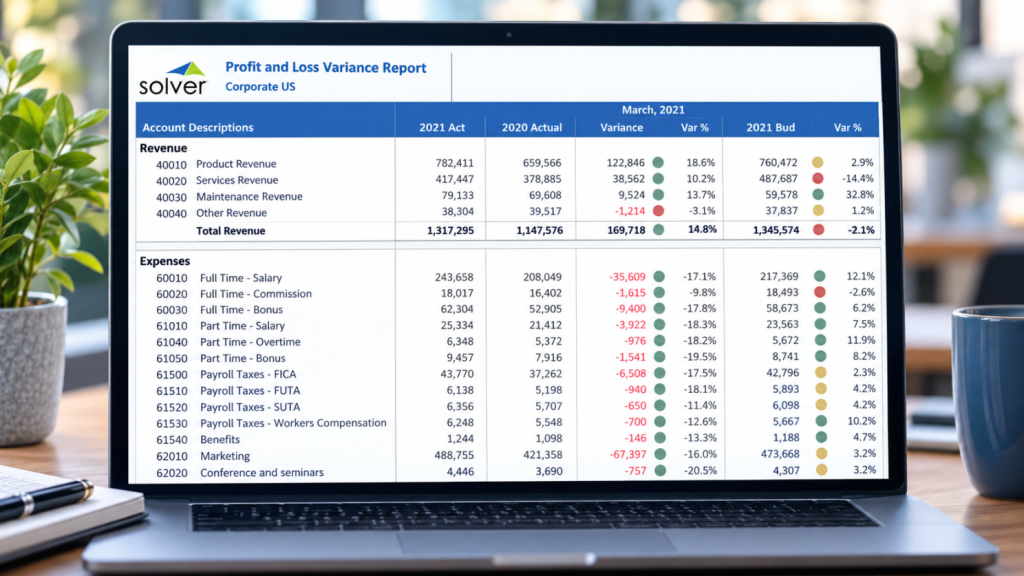
- Understand performance quickly
- Focus conversations on what matters
- Make decisions with confidence
- Move faster, not slower

