What if your payroll budget could work the way you wanted it to, rather than the way your budgeting template dictated?
Think about it. Why should every organisation calculate payroll costs in exactly the same way? Why should you have to compromise on your budgeting approach because a template only supports a limited set of assumptions or calculation methods?
Some organisations want to budget using annual salaries, while others need to account for pay cycles, working days or specific remuneration arrangements. Some need detailed modelling of employee benefits and additional remuneration components, while others have much simpler requirements. And many want a combination of approaches, applying different calculation methods to different components of their payroll.
The reality is that payroll budgeting isn’t one-size-fits-all. So we decided to build something that recognises that.
A different approach to payroll budgeting
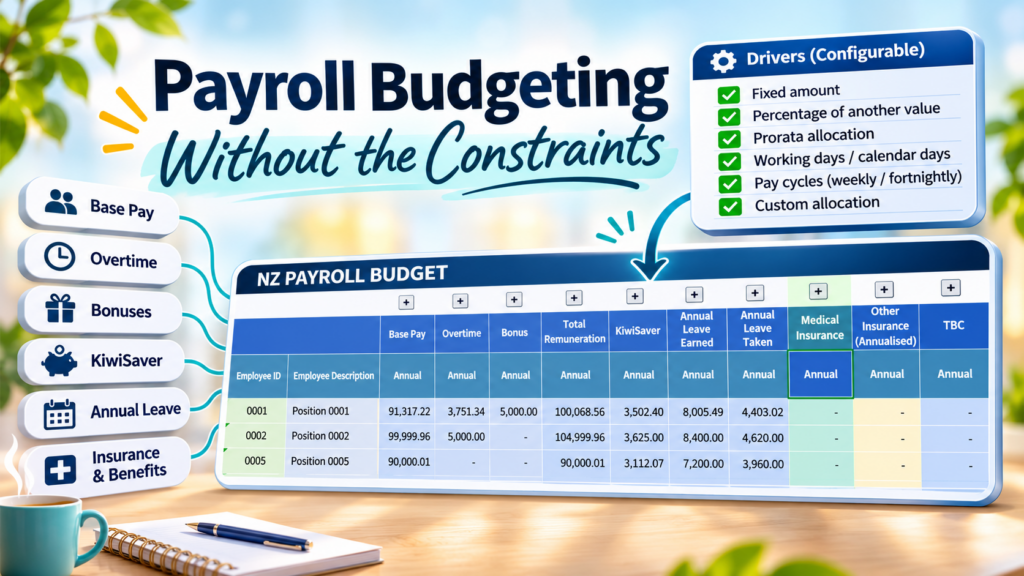
We’ve developed a New Zealand Payroll Budgeting module for Solver that puts flexibility at the centre of the design. Rather than prescribing how payroll costs should be calculated, the module provides a framework that allows organisations to determine their own approach, select the calculation drivers they need and customise the way individual components are budgeted.
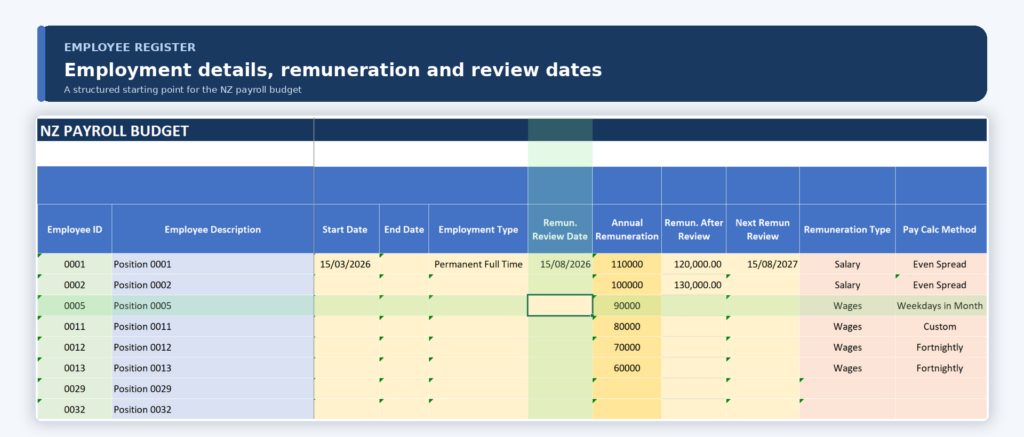
The solution is built around a structured employee register, with supporting functionality for calculating and allocating different remuneration components throughout the financial year. The real strength, however, is in the modular design. Each component can have its own calculation method and allocation logic, meaning you can mix and match approaches within the same budget rather than being restricted to a single methodology.
This is particularly useful for organisations with more complex remuneration structures, but it is equally relevant to those who simply want more control over how their payroll costs are forecast. You don’t have to use every available feature. You can use what you need, configure it to suit your requirements and leave out what doesn’t apply.
Your drivers, your rules
One of the most powerful aspects of the module is its configurable calculation drivers. Rather than hardcoding assumptions into the main template, we’ve separated the drivers into a dedicated worksheet. This gives users the ability to control how individual payroll components are calculated and how costs are distributed across the financial year.
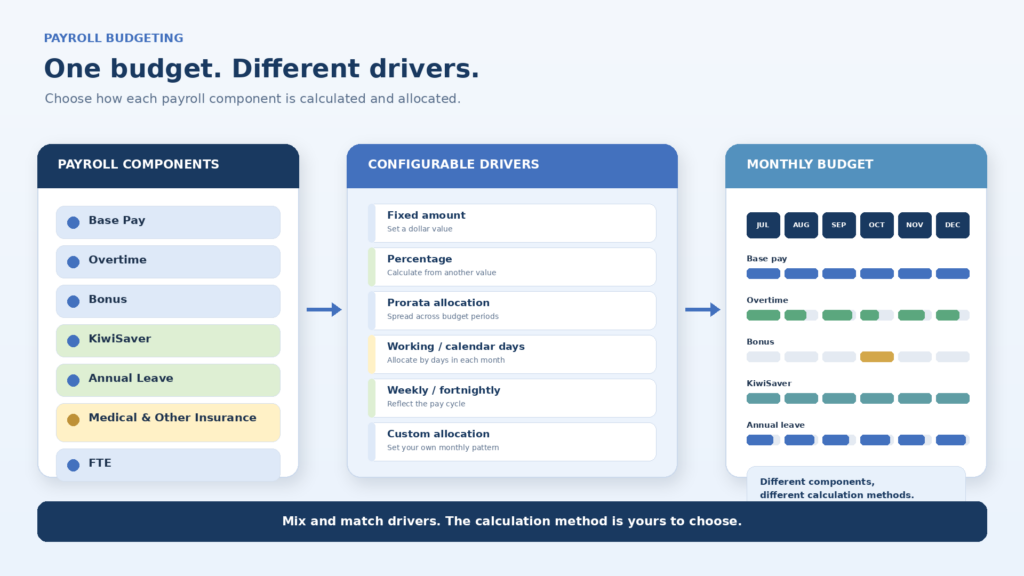
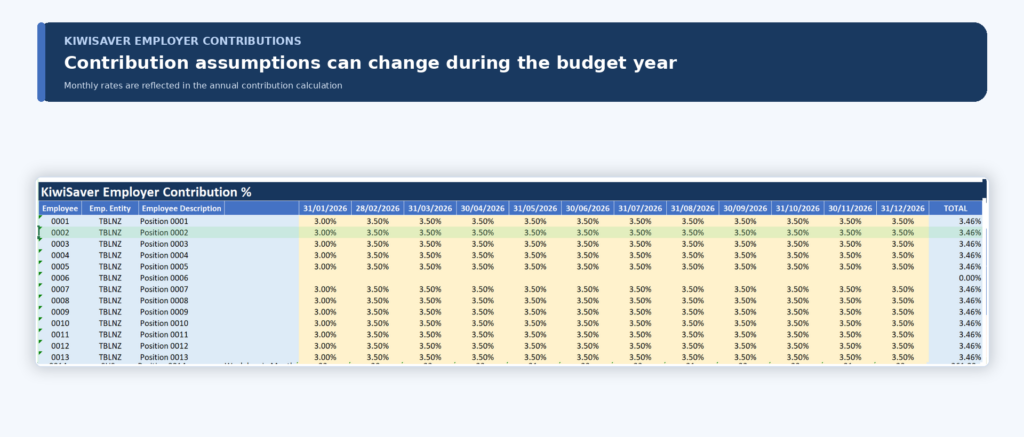
There are several different calculation approaches available. A component can be based on a fixed dollar amount, calculated as a percentage of another value, or allocated using a prorata calculation. For example, employer KiwiSaver contributions can be calculated as a percentage of base pay, while an insurance cost might be entered as an annual amount and allocated across the year. Other components can use entirely different calculation methods
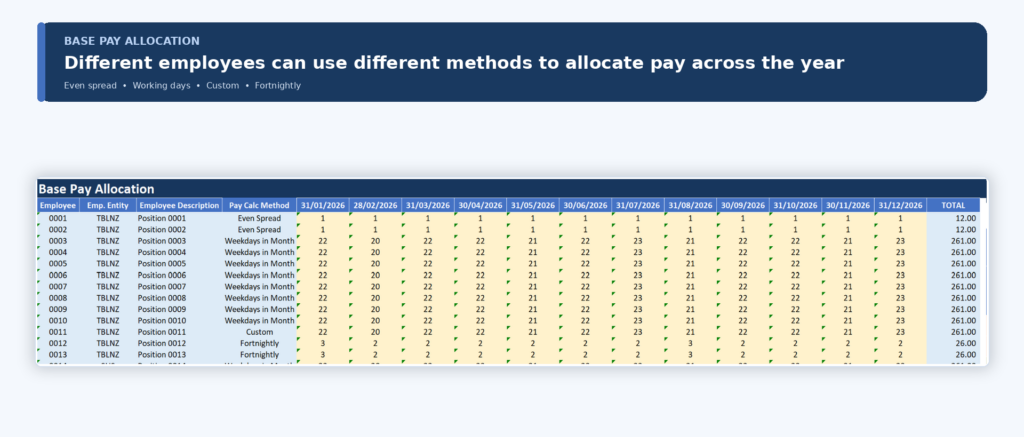
Even within prorata allocations, users have choices. Amounts can be spread evenly across the year, allocated based on the number of calendar days in each month or calculated using working days. There is also provision for weekly and fortnightly pay cycles, as well as custom allocation patterns where a standard monthly allocation doesn’t reflect the way an organisation operates.
The important distinction is that these approaches can be combined. You might use working days to calculate base pay, a percentage-based driver for KiwiSaver, a fortnightly allocation for another component and a fixed monthly amount for medical insurance. The choice is yours. The template provides the framework, but you determine the assumptions and calculation methods that drive the budget.
More than just base salaries
A comprehensive payroll budget needs to consider the full cost of employing people, not just their annual salaries. Depending on the organisation, additional remuneration and employment-related costs can represent a significant part of the overall workforce expense. Overlooking these components can result in an incomplete picture of what it actually costs to employ people.
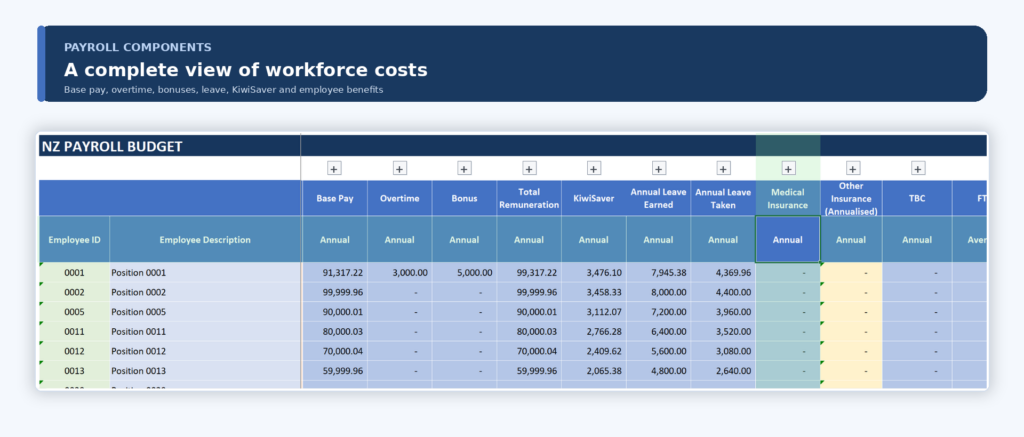
The module provides for a range of components, including base pay, overtime, bonuses, total remuneration, employer KiwiSaver contributions, annual leave earned, medical insurance and other insurance costs. FTE is also catered for, with the ability to calculate it using supporting drivers. Each component has its own place within the model, allowing costs to be budgeted and reviewed independently.
The different components don’t all have to be calculated in the same way. For example, medical insurance can be maintained as a monthly amount within the Drivers worksheet, with the calculation taking employment dates into account. Other insurance costs can be entered as an annual amount in the payroll template and allocated across the financial year using percentages or other allocation drivers. This gives users the ability to choose a calculation method that is appropriate for the particular expense, rather than applying a blanket assumption across everything.
The result is a more complete and transparent view of workforce costs, with the flexibility to accommodate different remuneration structures and employment-related expenses.
Accounting for changes in your workforce
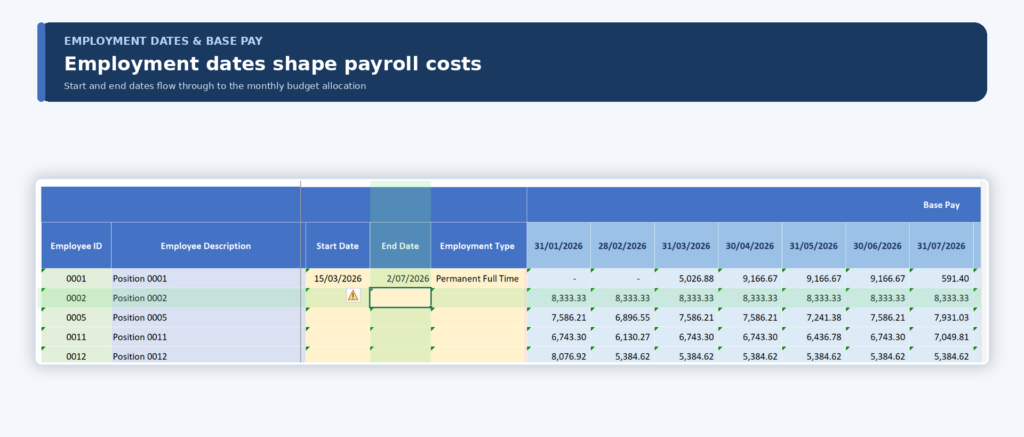
A payroll budget needs to reflect the reality that people join and leave organisations, and employment arrangements change over time. A new employee starting partway through the financial year shouldn’t necessarily have a full year’s remuneration included in the budget. Similarly, an employee leaving partway through the year should not continue to contribute to the forecast beyond their employment end date.
The employee register includes employment start and end dates, remuneration information and review dates, providing the structure needed to account for changes during the budgeting period. The calculation logic can take employment dates into consideration when allocating costs, rather than simply spreading an annual figure across every period regardless of when someone is employed.
Remuneration review information is also included, allowing organisations to capture details such as review dates and remuneration following a review. This is particularly useful when planning for salary changes and understanding how workforce costs may evolve throughout the year. Rather than treating the employee register as a static list of annual salaries, the model provides a foundation for more considered workforce cost planning.
From payroll budget to financial budget
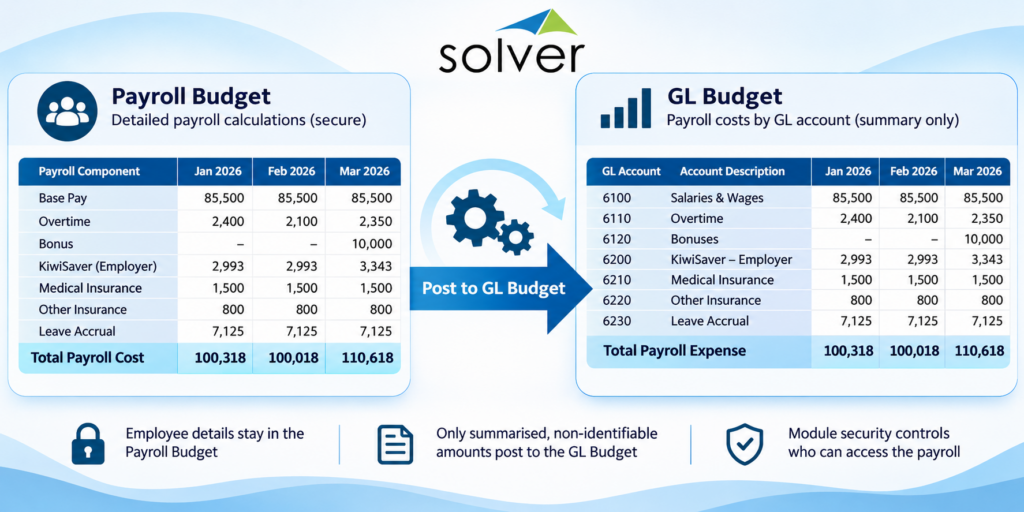
The payroll module is built within Solver, so payroll costs can be written back to the wider financial budget alongside other income and expenses. General ledger writebacks transfer payroll costs in summary format, with supporting writebacks for annual remuneration and drivers.
Keeping employee information where it belongs
Detailed employee information, remuneration and payroll calculations remain within the payroll budget. Only summarised, non-identifiable costs are transferred to the GL budget, keeping payroll detail out of the general ledger.
Organisations can also use position references rather than employee names in the payroll template, and apply module-level security to restrict access to authorised users.
Flexibility without unnecessary complexity
The employee register holds employee and remuneration information, while a separate Drivers worksheet manages the calculation assumptions and allocation methods.
Organisations can configure the components and methods they need, without having to use every available feature. The result is a payroll budget that can be as simple or as detailed as their requirements demand.
Payroll budgeting that works the way you do
There is no universal approach to payroll budgeting. Organisations have different remuneration structures, employment arrangements, pay cycles and ways of managing workforce costs. A useful budgeting solution needs to recognise those differences rather than forcing everyone into the same calculation model.
Our New Zealand Payroll Budgeting module for Solver has been designed with that principle in mind. By combining a structured employee register, modular remuneration components, configurable calculation drivers and flexible allocation methods, it gives organisations greater control over how they plan and forecast their payroll costs.
Ultimately, the objective is to provide finance teams with a practical, adaptable solution that supports the way they want to budget, while connecting payroll planning to the wider financial budgeting process.
A good budgeting solution shouldn’t dictate how you work. It should give you the flexibility to work the way you need to.