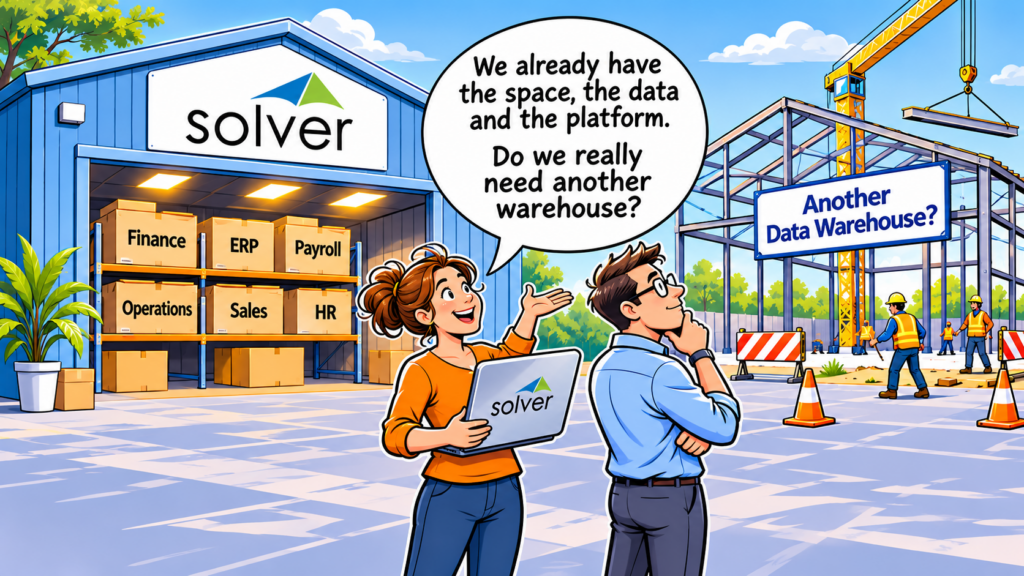
You might already have the data platform you need.
When businesses look to consolidate data, improve reporting or make information available across multiple applications, a new data warehouse is often part of the conversation. But adding another platform isn’t necessarily the answer. Before starting a new project, it’s worth understanding what your existing systems can already deliver.
Solver is widely recognised for budgeting, forecasting and financial reporting. However, its Data Warehouse offers considerably broader capabilities. Built on Microsoft Azure, it provides a central environment for consolidating business data and making that information available to other tools and applications.
For organisations already using Solver, this presents an opportunity to simplify their data architecture and get more value from an existing investment.
More Than a Financial Reporting Platform
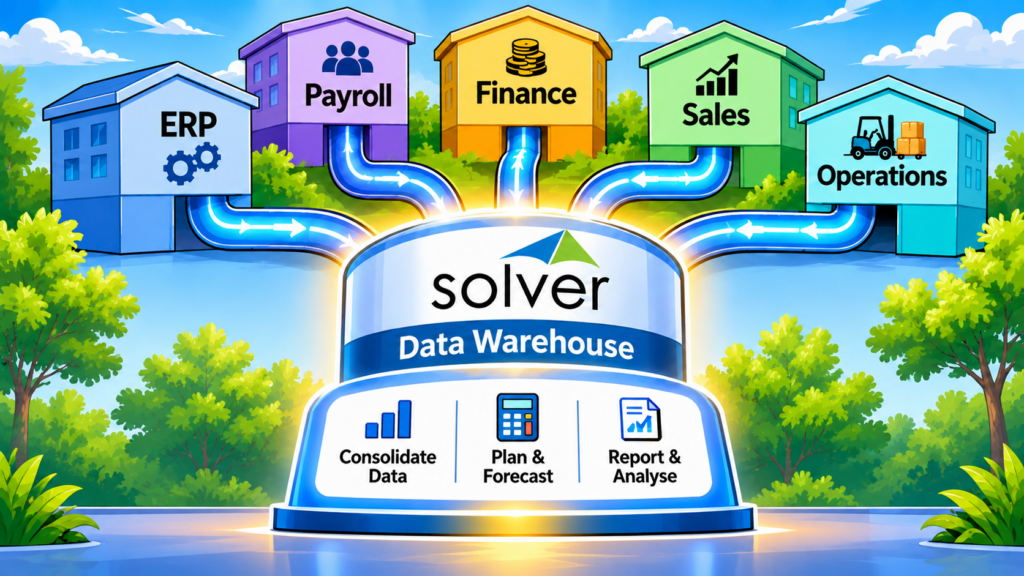
Business data is rarely held in one place. Financial transactions may sit in an ERP, payroll information in a separate system, and operational data across a range of business applications.
Solver Data Warehouse brings information from these different sources together, creating a consolidated data environment that supports financial planning, reporting and broader business analysis.
Importantly, the data isn’t restricted to Solver’s own applications. It can also be made available to other systems, extending the value of that consolidated information across the organisation.
Connecting Your Data to Other Tools
Solver Data Warehouse supports access through both its API and Microsoft Power BI.
This means organisations can use consolidated Solver data to build Power BI dashboards, visualisations and analytical reports, without necessarily needing to create a separate data warehouse to supply them.
For businesses already consolidating information in Solver, this is an important consideration. Rather than duplicating integrations and data pipelines in another environment, they may be able to use the existing Solver infrastructure to meet their wider reporting requirements.
Consider the Cost of Another Platform
A separate data warehouse may be entirely justified in some circumstances. However, it also introduces additional considerations beyond the initial implementation.
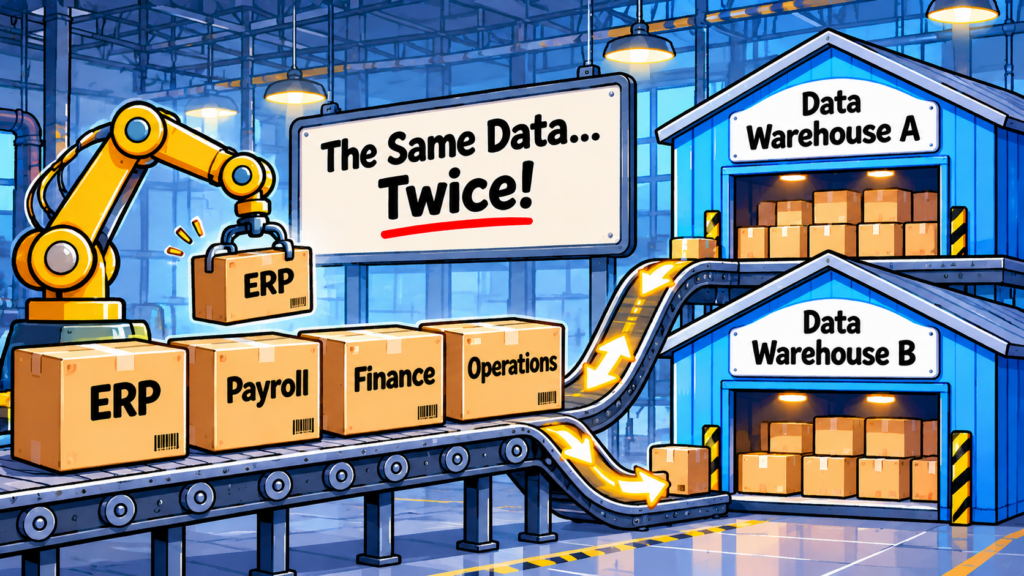
Data integrations need to be established and maintained. Pipelines must be monitored, data quality managed, and refresh schedules coordinated. Where information is duplicated across multiple environments, additional processes may also be needed to keep everything consistent.
Before committing to another platform, consider:
- Existing capability: Can Solver Data Warehouse supply the information required by your reporting tools and other applications?
- Additional value: Would another warehouse provide genuinely new functionality, or simply replicate data you already have?
- Total cost: Does the additional capability justify the implementation, integration and ongoing maintenance costs?
The objective isn’t to avoid additional technology at all costs. It’s to ensure that any new investment solves a genuine business requirement rather than duplicating existing capability.
Make Better Use of What You Already Have
A good data architecture isn’t necessarily a complex one. It’s one that brings information together effectively and makes it accessible where it’s needed.
For organisations already using Solver, its Data Warehouse may provide more of the data infrastructure they need than they realise. With the ability to consolidate information, support Solver’s planning and reporting applications, and supply data to Power BI and other systems through its API, it’s worth exploring those capabilities before investing in another solution.
Before You Build Another Data Warehouse, Talk to Turtle Bay
At Turtle Bay, we help organisations get more from Solver Cloud, from financial reporting and budgeting to data consolidation and broader reporting requirements. If you’re considering a new data warehouse or reviewing your existing data architecture, we can help you assess whether Solver already has the capabilities to meet your needs.