Less hard-coding. More flexibility. Better reporting.
Ever inherited a financial report with hundreds of rows, dozens of columns and a layout nobody wants to touch? Perhaps it takes forever to run, and even a small change to the business structure means hours of rework.
The problem might not be your data. It might be how your report is designed.
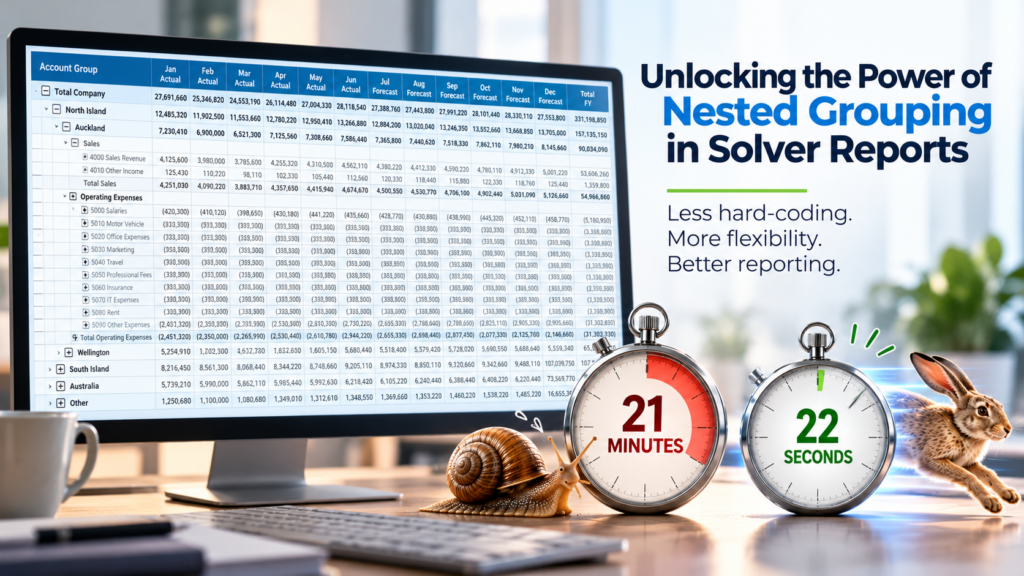
From 21 Minutes to 22 Seconds
A few years ago, we worked with a client using who had a complex report taking approximately 21 minutes to render.
Using nested expanding groups, we redesigned the report to just three columns and six rows. The result? 22 seconds instead of 21 minutes.
We hadn’t simply stripped out the detail. We’d changed how the report was built. The result was a much more compact report design, without the need to hard-code every combination of information.
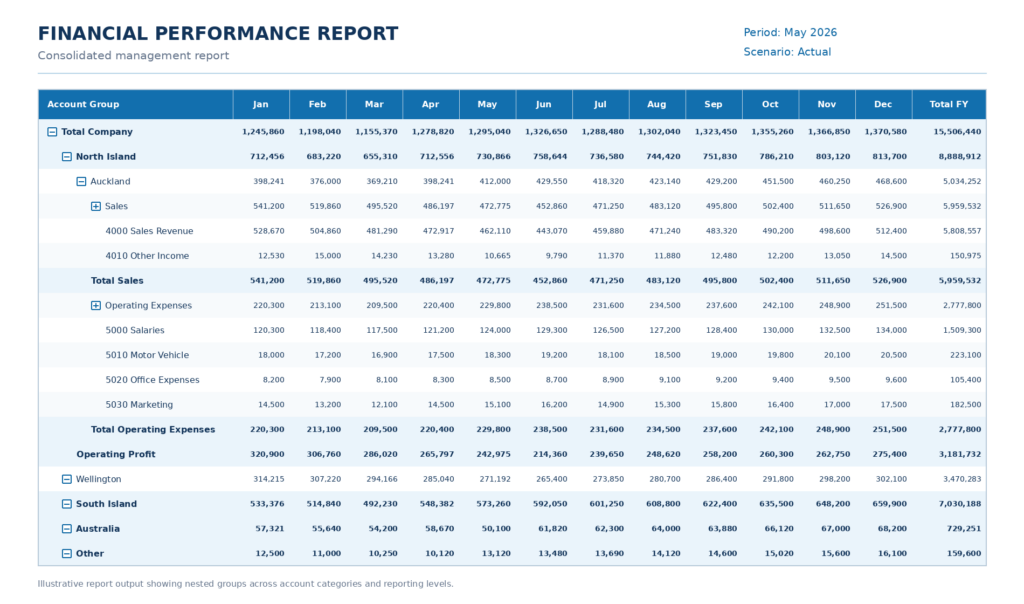
Think Hierarchy, Not Hard-Coding
Nested expanding groups let you build a reporting structure into the report design rather than manually accommodating every possible combination.
Imagine a consolidated financial report that needs to present results by island, then region, then account. Instead of building a sprawling layout to accommodate every combination, you can configure nested groups to organise the information into the required structure.
As the report runs, the groups organise the relevant detail according to the design. Expanding groups can also accommodate new dimension members, helping the report remain useful as the business changes.
The result is a more flexible report that can present detailed information without requiring every possible row or column to be built manually.
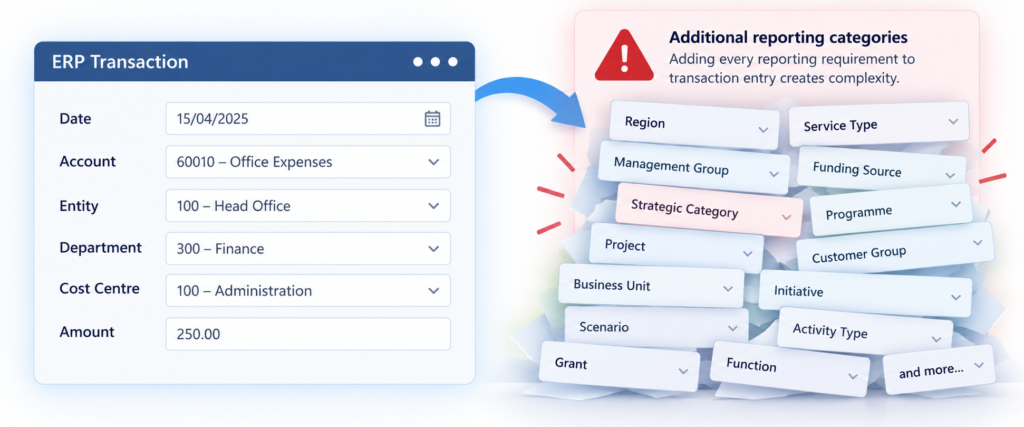
By adding attributes to dimensions in Solver, you can introduce these additional reporting perspectives without requiring every classification to exist in your source system.
Attributes provide additional ways to classify dimension members, while the report’s grouping and sorting configuration determines how information is organised in the output. They serve different purposes, but together they can give you greater flexibility in designing reports around the way management wants to view the business.
Build Reports That Adapt
A report should make information easier to understand, not harder to maintain.
Nested expanding groups can simplify complex report designs, while dimension attributes allow you to introduce reporting classifications beyond those available in your ERP.
If your Solver reports are becoming unwieldy, it may be worth looking at the report design before assuming the data is the problem.
Talk to Turtle Bay about getting more from Solver Report Designer.